 It’s hard to know exactly the date of this photograph. The view is in front of the office building. Oxen were frequently used to haul the granite up to the cemetery on sledges. The arch was erected in 1873. To see the image at full size, click on the photo above. (photo courtesy of Oak Grove Cemetery).
A Foggy Winter Twilight
The Kelly/Hart Connection
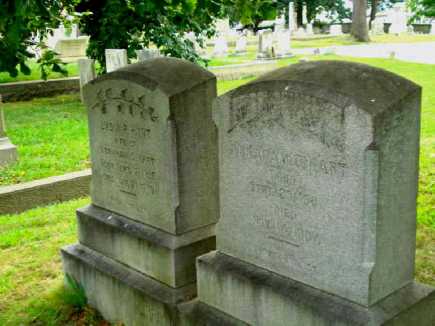
Lydia and Abraham Hart gravestones
Banker, Abraham Hart, was one of the last people to see Andrew Borden alive on the morning of August 4th 1892 when Andrew stopped by the bank near City Hall. Mr. Hart would later tell police that Mr. Borden looked weak and feeble that morning. The Bordens had been suffering from an unknown illness since Tuesday evening after supper. Abraham Hart would also be one of the Borden pallbearers on the morning of Saturday, August 6th at the short service at #92 Second Street and procession to Oak Grove Cemetery.
Dr. Michael Kelly, the Borden’s next door neighbor to the south was away on August 4th but Dr. Kelly’s wife, Mary Caroline Cantwell Kelly was the last (but one) to see Andrew Borden alive as he entered his front door moments before his murder. Mrs. Kelly was expecting a baby at the time and was on her way to the dentist. Mrs. Kelly’s second child, Mary Philomena married the grandson of Abraham Hart, Bertrand K. Hart. Both are buried in the Gifford/Hart plot at Oak Grove, directly across the path from the Rev. Augustus Buck, Lizzie’s minister and champion throughout her ordeal. All are together for eternity in a fascinating entertwining of personalities who had Lizzie Borden in common.

Bertrand and Philomena Kelly Hart
 The Rev. Augustus Buck of the Central Congregational Church
Mailbox- The Borden Marker
Elaine Kessell
(edit)
I am finally in the process of doing my family tree. My great grandfather’s name was Nicholas Kessell and I have always known he was a stonecutter in Fall River Mass in the mid to late 1800′s as he past on in 1904 of “stone consumption”. I came across a book “The Fall River Directory of 1882 and notice an ad in there for Kessell and Lawson, a stonecutting company. I can only guess that my great grandfather was in that partnership. My question is, if there is anyway you could find out if he was all involved in the cutting of the Borden tombstone in 1892? I have been intrigued all my life, but now am very curious.
Thank you,
Elaine Kessell
There is never any information about stonecutters.
Thanks for your email. Sorry to say, the Borden stone was ordered from a Westerly, R.I. carver. Westerly was a hub for this sort of work and still today has a few remaining carving studios. Buzzi’s is still in business (Ruth Buzzi of Laugh-In fame is in that family) The Borden stone was installed in January of 1894 and is made of Westerly blue granite. Fall River also had some great carvers and a rosy-colored granite.
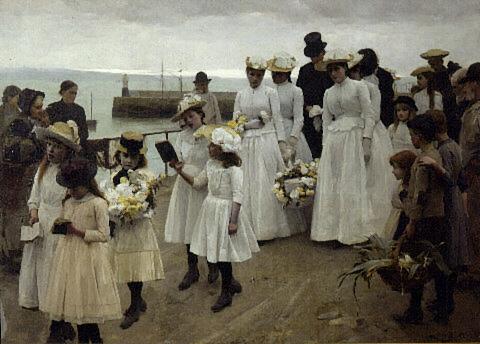
The custom of Maidens’ Garlands
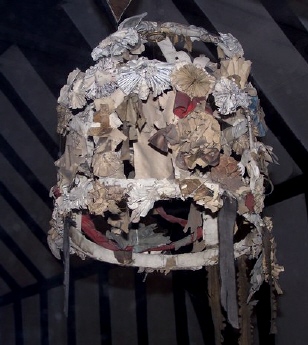
In the mailbox today we received a query about Maidens’ Garlands- a custom which seems to have originated, or else was extremely popular in 19th century Great Britain. When a maiden lady passed away, especially a very young, unmarried girl, it was a custom for young  ladies of the parish to construct garlands which were solemnly carried before the casket by two maidens on the way to the cemetery. These garlands were constructed of white paper, and after the cemetery service were hung in the church. Also crowns of white living flowers were made which would be borne to the grave by maidens in flowing white dresses, generally processing in pairs. Statuary in Oak Grove frequently makes use of the symbolism of a crown of rosebuds, lilies, and garland swags for the grave markers of maidens.
A Maiden’s Garland still hanging in a church in England
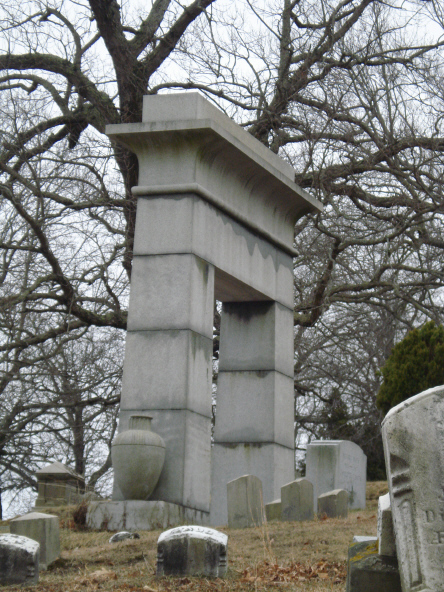
Arches, gates and doors

This particularly beautiful tall arch is to be found in the central west end of Oak Grove and is a familiar symbol of passing through from one state to another- from earthly to celestial, from life to the hereafter.
There are smaller arches, gateways and doors to be found in Oak Grove, some found carved onto tabular monuments and others carved completely as the symbol itself. This one has an Egyptian inspiration- complete with canopic jar.
Victorian mourning in art
A popular epitaph
As you are now, so once was I.
As I am now, so you must be.
Prepare for death and follow me.”
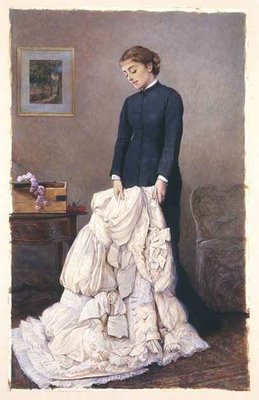
The Young Widow 1877, exchanging the wedding gown for mourning
The Victorian preoccupation with death is reflected in the art of the period. Photographs, paintings, death portraits, steel engravings, lithographs, etchings, and other art forms embraced the most sentimental and heartrending portrayals of loss and bereavement.
These works by both amateurs and the great artists such as Landseer and the Pre-Raphaelites were displayed in the parlor or sometimes in the bedchamber as a perpetual reminder that death is always with us.
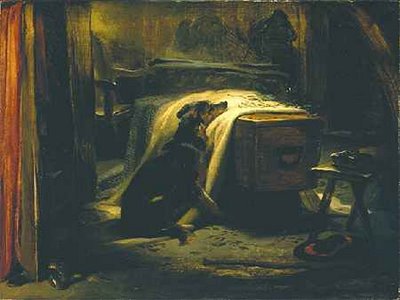
The Old Shepherd’s Chief Mourner by Landseer
Animals and children were especially popular as subjects to portray pathos and grieving.
 Friends of Oak Grove Cemetery