Victorian Sentimentality in Music

piano.jpg 

Before the radio, every home which could afford it had a parlor piano, and most young ladies of the family could “play a little”.  The hymnal was a standard to be seen on the music rack, as well as ornate, over-sized pages of sheet music which featured vignettes of touching scenes on their covers.  The tunes were sung to dozing infants in front of the fire, and passed down from generation to generation.

Some of the most sentimental and poignant melodies were inspired by the Civil War, and many featured heart-rending lyrics about waiting mothers.  Perhaps the most popular melody of this type was Just Before the Battle, Mother.

justbeforethebattlemother.jpg

The themes which were so universal to tender hearts everywhere dealt with loss and grief, separation and death.  Motherhood was held in such high regard that many songs had a grieving mother, a mother lost to death, or a child’s loss of its mother as themes.  These became known as “tearjerkers” and were a staple of the music writer’s industry for a time well after WWI.   The Baggage Coach Ahead is one such very popular sad song about the loss of a mother and a father’s explanation to a little child about the mother being in the “baggage coach ahead” as they were taking her body home for burial.  Many of these songs have entered into the realm of American folk music.  Many of the lyrics were written by  women, some were mothers.

baggage-coach.jpg

http://www.iment.com/maida/family/nana/baggagecoachahead.htm

To hear some of these old favorites, visit the links below- you may need a handkerchief.

http://www.mi5th.org/Songs/JustBefore.htm

http://parlorsongs.com/issues/2006-3/thismonth/feature.asp

http://parlorsongs.com/issues/2001-10/thismonth/featurea.asp


letter2.jpg

The Harvest of Years

wheat21.jpg

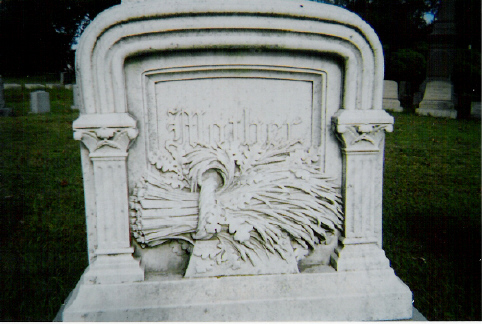
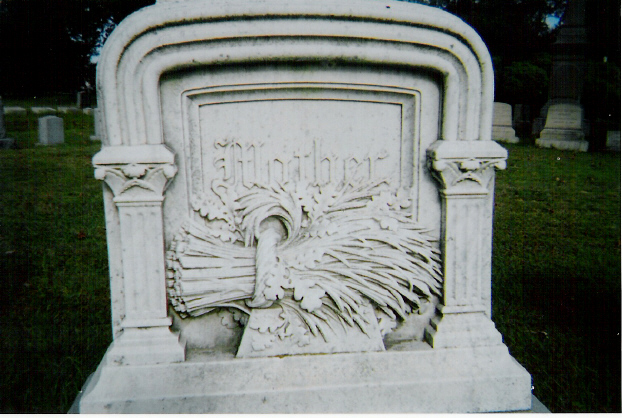
Another symbol which was particularly popular on headstones of men who had lived a long span of 70 or more years was the sheaf of wheat.  There are several excellent examples carved in very high relief to be found at Oak Grove. The symbolism of gathering in the harvest of years parallels the familiar figure of Death, with his scythe, preparing to reap the harvest at Life’s end. 

 srreaper4.jpg Gustave Dore’s Grim Reaper

 Occasionally one sees a single blade of wheat, millet, oats, or another cereal grain.

wheat.jpg

Images in Black and White

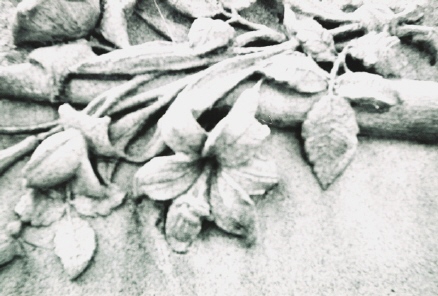
weisse_rose.jpg Oak Grove may well be one of the best places in the state to find examples of Victorian funeral symbolism, which was a language understood by all who passed through the cemetery in the nineteenth century. The Language of Flowers had long been a part of Victorian sentiment, and this transfered to the grave as well. Ladies often received floral tributes in stone of roses, ivy, fern and lilies signfying hope for the resurrection of the body on the Day of Judgement, love, humility and sincerity (fern) and the clinging ivy (undying affection). Other symbols shown in the black and white slide presentation below are:
Olive branch– peace , Oak leaves– strength, fidelity, endurance, Palm- victory, triumph over death, Laurel wreath– victory, eternity, immortality, Anchor– hope or a career on the sea, Scroll or Book– Book of Life, scroll of St. Peter, Roll of the Saved, Doorway or Arch– portal between heaven and earth, Urn– harking back to Egyptian canopic jars, containers of the Spirit, Curtain– the end of the worldly life, Wreaths, Swags and Garlands– victory over death, immortal circle, honor, Lamb– grave of an infant or child.

All of the black and white photographs were taken with an inexpensive disposable camera using Kodac black and white film. Although it is pleasant to walk in cemeteries on sunny days, some of the best photographs are obtained on overcast days when shadows and bright sun do not interfer with capturing the sculptural detail in dark bas-relief. Keep a disposable camera camera handy in the glove compartment, for you never know when you may wish to capture an image of a particularly remarkable monument.

[slideshow id=576460752330284866&w=600&h=475]

The Granite Entry Arch 1873

 Perhaps the most recalled image of Oak Grove is its graceful granite Gothic Revival archway on the west side of the cemetery.  Prospect Street terminates under the arch.  Although the cemetery itself was designed in 1855 by Josiah Brown ( a city surveyor and architect), the archway was constructed in 1873.  The archway style is not unique to Oak Grove, and may be found in other New England cemeteries of the period.  “Oak Grove” is one of the most popular cemetery names in America, and in Fall River’s case, it is appropriate due to the extensive planting of oak trees on the nearly 100 acres of land.

What is remarkable are the exquisite wrought iron gates on either side of the arch; on the right, in front of the office, on the left, in front of the former Ladies Comfort Station. It is unfortunate that no photographs exist of the raising of this arch in 1873, for it must have taken ingenuity and strength.  Visitors to the cemetery who pass beneath this arch always pause to read the inscription :

The Shadows Have Fallen And They Wait for the Day

Lily- The Flower of Mourning

 lilynew.jpg

An Oak Grove granite lily

Perhaps there is no one flower more associated with mourning, funerals or grave stones than the lily.  Madonna lily, calla lily. or other varieties, with their bell- shaped blossoms and heavy perfume were a favorite of Victorian mourners at the wake, on the grave and carved on stones for the female Departed.  Oak Grove has a veritable field of beautiful carved granite and marble lilies.  In an excellent description from the web site The Art of Mourning, the meaning behind the symbol is explained.

“Lily: Majesty, innocence, purity, and resurrection. Often associated with the Virgin Mary and resurrection. Often used on women’s graves. The use of lilies at funerals symbolizes the restored innocence of the soul at death.”

For other interpretations of Victorian plant symbolism, visit  http://www.artofmourning.com/symbolism.html#plants