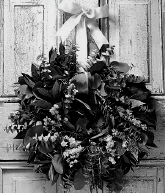
Curtains would be drawn and clocks would be stopped at the time of death. Mirrors were covered with crape or veiling to prevent the deceased’s spirit from getting trapped in the looking glass. A wreath of laurel, yew or boxwood tied with crape or black ribbons was hung on the front door to alert passersby that a death had occurred. The body was watched over every minute until burial, hence the custom of “waking”. The wake also served as a safeguard from burying someone who was not dead, but in a coma. Most wakes also lasted 3-4 days to allow relatives to arrive from far away. The use of flowers and candles helped to mask unpleasant odors in the room before embalming became common. In 19th century Europe and America the dead were carried out of the house feet first, in order to prevent the spirit from looking back into the house and beckoning another member of the family to follow him. Family photographs were also sometimes turned face-down to prevent any of the close relatives and friends of the deceased from being possessed by the spirit of the dead.
Grave robbery by the “Resurrectionist Men”, often doctors themselves was a problem in the 19th century as medical schools needed fresh cadavers for dissection classes. “Bricking-over” a grave was a way of guaranteeing some security after death. The fear of a loved one being buried alive inspired coffin makers to design warning systems such as a bell on the grave which was connected by a chain to the inside of the coffin in cases of premature burial, thus the expression, “Saved by the bell.” Small cakes, known as “funeral biscuits” were wrapped in white paper and sealed with black sealing wax and given to guests as favors. Lavish meals, or collations, were often served after internment. Burial usually followed four days after death.
In many cemeteries, the vast majority of graves are oriented in such a manner that the bodies lie with their heads to the West and their feet to the East. This very old custom appears to originate with the Pagan sun worshippers, but is primarily attributed to Christians who believe that the final summons to Judgment will come from the East.
Personal stationery and handkerchiefs carried a black border, with a wide border indicating a very recent death.
White was a popular color for the funeral of a child. White gloves, ostrich plumes and a white coffin were the standard.
Some Victorian superstitions:
If the deceased has lived a good life, flowers would bloom on his grave; but if he has been evil, only weeds would grow.
If several deaths occur in the same family, tie a black ribbon to everything left alive that enters the house, even dogs and chickens. This will protect against deaths spreading further.
Never wear anything new to a funeral, especially shoes.
You should always cover your mouth while yawning so your spirit doesn’t leave you and the devil never enters your body.
It is bad luck to meet a funeral procession head on. If you see one approching, turn around. If this is unavoidable, hold on to a button until the funeral cortege passes.
Large drops of rain warn that there has just been a death.
Stop the clock in a death room or you will have bad luck.
To lock the door of your home after a funeral procession has left the house is bad luck.
If rain falls on a funeral procession, the deceased will go to heaven.
If you hear a clap of thunder following a burial it indicates that the soul of the departed has reached heaven.
If you hear 3 knocks and no one is there, it usually means someone close to you has died. The superstitious call this the 3 knocks of death.
If you leave something that belongs to you to the deceased, that means the person will come back to get you.
If a firefly/lightning bug gets into your house someone will soon die.
If you smell roses when none are around someone is going to die.
If you don’t hold your breath while going by a graveyard you will not be buried.
If you see yourself in a dream, your death will follow.
If you see an owl in the daytime, there will be a death.
If you dream about a birth, someone you know will die.
If it rains in an open grave then someone in the family will die within the year.
If a bird pecks on your window or crashes into one that there has been a death.
If a sparrow lands on a piano, someone in the home will die.
If a picture falls off the wall, there will be a death of someone you know.
If you spill salt, throw a pinch of the spilt salt over your shoulder to prevent death.
Two deaths in the family means that a third is sure to follow.
The cry of a curlew or the hoot of an owl foretells a death.
A single snowdrop growing in the garden foretells a death.
Having only red and white flowers together in a vase (especially in hospital) means a death will soon follow.
Dropping an umbrella on the floor or opening one in the house means that there will be a murder in the house.
A diamond-shaped fold in clean linen portends death.
A dog howling at night when someone in the house is sick is a bad omen. It can be reversed by reaching under the bed and turning over a shoe.


“A dog howling at night when someone in the house is sick is a bad omen.”
-THIS IS A SUPERSTITION KNOWN ALSO IN THE PHILIPPINES AND EVEN IN ITS SMALL PROVINCES LIKE EASTERN SAMAR.
“Lavish meals, or collations, were often served after internment.”
-THIS IS ALSO A TRADITION OF THE FILIPINO PEOPLE.
a dog howling means there is going to be a death ,exspesialy to the owners of the dog in romany superstition
Not to politicize things, but a certain number of English funeral customs probably came over from Ireland with waves and waves of Irish who came to work as laborers and serving women in England over the centuries. The Irish certainly have many, many funeral customs and superstitions about death and certainly they turned the idea of the wake into an artform – Irish wakes sometimes became so rowdy that the corpse was taken out of the box and dragged around the dance floor, or a bottle or glass placed in his or her hand, or a hat on the head. At any rate, what I was taughht among other things was that you wear black to appear as a “shadow” rather than a body so the dead person’s spirit won’t enter your body. Irish women are in charge of a wake and funeral preparations. First all windows are opened and the body is washed and dressed. I was told by a nurse here in America that in the days before modern hospitals with sealed windows the Irish nurses would always be quick to enter the room of a dead person and open the windows. Also, whiskey is often poured onto the dead person’s favorite possessions or things associated with them, just a bit in their honor. So a fiddler or a piper might have a bit of whiskey from the toast bottle poured on his fiddle or pipes.
That was very interesting thanks for the info
Very interesting. Anyone know anything about Maidnes’ Garlands”
whenI was a child passing funeral procassions passing houses, it was custom to pull the curtains or draw the blinds, this to prevent the dead from entering your home, but I feel my mother did it to make the grieving family feel they wear not being “gawped at”. Also a coin was left at the gate of the deceased family home. this was central Scotland cica 1960’s
It used to be that when a person died, the body went out of the house feet first. Is this correct?
The office can be found on the right as you go in through the Prospect Street arch. Tammie is in the office during the week and can look up your family member and give you a small map of where to find the marker in the cemetery. Hope you find what you are seeking.
my husband just told me after i read him the list of superstions that his mother (still living) used to and still does turn over a shoe under the bed when the dogs howl outside at night . it’s interesting the way old superstions have no borders races or colors. they translate well through many different places in the world.
this artical was helpful
I was glad to see the custom of the “irish women opening windows when someone died” commented upon because I’ve not met anyone else Irish who knew this custom.
Many of these customs have faded out over the decades as superstitions and practices from the old country have died away with the passing of our great grandparents and Victorian ancestors.
I was a Registered Nurse most of my adult life and, I am Irish I always opened the window after a death in hospital if only for a few minutes to allow the spirit of the deceased to be on its way. Old habits die hard!!
As a child in the fifties we all repeated this rhyme whilst holding our collars if a funeral hearse passed by:
Hold your collar
Never swallow
Never catch a flea
None for me
None for you
None for all the family!
My Irish nana was very superstitous in that respect. She used t leave a plate food on the doorstep on Halloween. The custom against opening umbrella’s indoors is still alive and well in my household. I, myself will do anything possible to avoid walking on somene’s grave. When one of my great uncle’s died in the 60’s in Irelandmy Irish grandfather naturaly went to the funeral, and my English nana says she heard the banshee on the day of the funeral? Lastly i was told when i was 11 that it was bad luck to take photographs of graves.
my mother passed away feb 25 this year and within the last month a crow started pecking on a den window and then when it heard me talk in followed to my bedroom window,then peck on my bedroom door that leads outside and then moved to 2nd bedroom window. wherever it hears it follows me.it even wakes me up around 6 ampecking outside my window by the head of my bed we have heard if someone hhas recently died in your family their spirit is in that bird also heard it means death to a family member does in mean inside the home the crow is pecking on or just close family
I had heard the custom of the 3 knocks from my grandmother and I have experienced this on more than one occasion (weird coincidence?…)
Growing up in a home full of Irish traditions, nothing is strange to me. My husband on the other hand thinks we are all crazy. The only tradition that ever bothered me was covering the mirrors and the photographs. Imagine how frighting it was as a child to go home after a family members wake and have to look in the mirror for the first time in 4 days. lol. I talk about these superstitions with my own children now that many have phased out since my grandparents and great aunts and uncles have passed. They think it’s interesting. Family traditions (not just death and funerals) are very important to our family. It’s our way of keeping our heritage, culture, and loved one who have passed close to our hearts.
betty says:
May 13, 2011 at 7:03 pm
my mother passed away feb 25 this year and within the last month a crow started pecking on a den window and then when it heard me talk in followed to my bedroom window,then peck on my bedroom door that leads outside and then moved to 2nd bedroom window. wherever it hears it follows me.it even wakes me up around 6 ampecking outside my window by the head of my bed we have heard if someone hhas recently died in your family their spirit is in that bird also heard it means death to a family member does in mean inside the home the crow is pecking on or just close family
Reply
I BET YOU THINK THAT i BELIEVE THIS..!!
what type, colours, amounts of fragrant flowers were used in victorian times for home funerals? were flowers placed all through out the house? what would have been done at Christmas? would the family clebrate as always? namaste eliz
I understand the meaning of the tradition of being carried out feet first in your coffin is because you “Come into the world head first and go out feet first.”
I remember being horrified of pictures taken of the dead in Victorian times. It was used in a Nicole Kidman movie in an interesting way. Since then, I have seen quite a few of these post mortem portraits and wonder what the emotional payoff was, as I would only have nightmares remembering my loved ones dead. I always remember them as full of life and feeling. I know that artists often drew their loved ones, and that famous people had death masks made (this was actually an ancient Roman custom, taken in wax, and worn by the living to invite the dead to important family events). My view is that photography was like magic back then, and the idea of keeping an image was a way to remember the person. Not many people got portraits made. It must have been quite a picture to watch a funeral in ancient Rome with portraits of the dead ancestors walking in the procession!
Can you tell me what they call the window/door that was used to move the dead body from the home? I have heard it called “death’s door” hence the expression of one being at death’s door. There is some superstition about moving the dead through the front door.
I was born in1951 from a scottish father and english mother we lived on one of the (new at the time) housing estates.
When any one died in the street on the day of the funeral all the curtains in all of the houses would be kept closed until the funeral party had left.
Also anybody on the street at the time of leaving the ladies would bow their heads and the men would doff their hats.
I still to this day keep all my curtains closed whenever there is a family funeral.
This is all part of the ritual of life, from churching after the birth till the time of leaving.
“A cat hissing when a body is laid is consider a bad omen”
I have also heard that a corpse should leave the house feet first and ALWAYS through the front door. Both sets of grandparents always came and went through the back door of their houses ( even though that meant walking past the front door) and the only time the front doors were used were for coming in carrying coal and silver after midnight on new years day ( having left via the back door just before the stroke of midnight), and when they died, and their coffins left the house.I am from Darlington , my grandparents all being from Durham.
I usually hear that 3 knock thing too, it scares the hell out of me..My father just passed 3 xmas’ ago and i was his #1,what does all this mean? Am i about to leave this world? I do think there is a God,they also say that some people just have a feeling before it’s time..What do you think?
There is a tradition in our family that women should cover their faces and indeed their heads before a corpse.
I remember the night that my mother in-law died by accident near our home. We saw an owl out side our window , it stayed every night
about a month . we had never seen it before . It called all night and then about a year later it came back but did not stay as long. we’ve never seen an owl there again
this is lovely
The superstition about the owl is mentioned in the list above. Seems like birds are an ill omen all around, pecking at windows, getting caught in chimneys, etc. Owls, crows, ravens are all harbingers of an impending funeral. Poe’s Raven perched above his chamber door is immortalized in verse, although there, Lenore, his Beloved, is already dead. My grandmother always said a black animal of any kind coming up on a porch or hanging about near the house
was an omen of death to come.
YES.bc its believed that if the body is carried out feet first then the spirit couldnt come back to haunt bc the spirit didnt know which house it came out of,and if the body came out head first,its believed thats the spirit can follow this trail back bc it remembers what the house looks like.
My American born Italian grandmother born in 1906 (on a farm in Manhattan) . Once said that when a person died that everyone in the house had to stay up all night and if you fell asleep they would blacken you face with coal or ash and then take a match and wake you up by giving you a hot foot.
After reading this info it seems to make sense now, it seems like it is all part of the same tradition the idea of a Wake! Seems like most of the traditions have be lost or just knowing about them and what people use to do. Often what we do today in a modern day wake is simply a continuation bit we have not been taught or forgot the meanings behind why we are doing it.
when my Husband passed away , a week later about 2am the front door bell kept ringing , we had to dismantle the bell , I often wonder if it was my Husband or just a electrical fault, it never happened again
As my Irish born father’s funeral procession entered the cemetery, it was raining. His Irish born cousin seated next to me stated it a good omen as surely he will go to heaven.
when my nan died a couple off years ago the day of the funeral it was a sunny day just as we were about to lowering the coffin in to the ground it started to rain the sun still shinning as soon as the coffin was in the ground it stopped raining a few months
later my mum died sudenley i never thought any thing till reading this( if it rains on a open grave someone in your family will die within a year)
another thing we always do is we always shut the curtains on the day of funeral
It is said if it rains at a funeral. Happy is the departed that the rain falls on.
Birds are popular to carry a message to the ones left behind that the departed one is now fine on the ‘other side.’ Butterflies too, as well as electrical anomalies, phones that ring but no one’s there. Stacked coins where you did NOT leave coins. Interesting little tidbits. People shouldn’t be so afraid of these; sometimes they’re a bit unnerving, but hey, so is Life.
One victorian supersition (at least in new england) i know is “whoever enters a graveyard carrying a casket will soon die” To solve this there was a hole the size of a casket in the iron fence around the cemetery. Whoever was carrying the casket would push it halfway through the hole then go around and pull it in the rest of the way. That way noone ever enters graveyard with a casket. In fact if you go to an old victorian graveyard that still has its original fence you may find the hole.
Interesting 🙂
Dragonflies are a symbol of rebirth or a renewal after a great hardship or loss. This is a belief in several Native American cultures. These people also believe that dragonflies hold the souls of people who have died. This insect (like the butterfly) is also known for the transformation from the earthly life to the life that continues in another dimension of existence. ❤ That sounds like it was a beautiful sign to witness!
To knock on wood three times after speaking ill will of anything was irish custom for releasing the bad luck that could follow.
these customs and or superstitions are all very interesting, i come from old hispanic families from the southwestern united states, where my ancestors settled in the 1600s, many of these customs, etc, are i believe european in origin, with probably some adaptations here in the u.s. i do notice that many of the irish customs are very similar to the my colonial spanish ancestors funeral customs, that brought with them from spain. michael martinez
Has anyone heard of a superstition concerning a knife falling to the floor? I had an uncle who died quite young, in the 1950s. His mother- my Irish-born grandmother- was at home at the time working in the kitchen. A knife fell on the floor and she announced to her family that the son was dead.
@ Sue: there are entire sets of superstition concerning falling or dropped flatware, china, and table accoutrements. Irish superstitions include: dropped or fallen knives=death of close relative, fallen spoons=illness, and forks meaning a visitor. Birds flying into the house are an omen of death, an owls hoot as well is negative omen. Iron shouls be hung above the door to stop bad luck as well as preventing the fae from entering the home and causing torment. If a drink (usually whiskey) is left unfinished it invites spirits into the home…May you be in heaven half ann hour before the devil knows you’re dead is a popular Irish blessing.
Very enjoyable reading. Love anything about the Victorian Era !
Kinda interesting and a little creepy. Thank god i dont hold my breath when i go by a cemetary.
In New York we would hang a wreath of fresh flowers on the door
Here in South Carolina, a spray of white carnations with greenery is placed on the front door of the deceased’s family.
I come from a Southern family and I believe the superstitoins. The bird pecking on a window or flying into a window means death will come to someone close soon. It happened within 24 hours of the deaths of My Mother, My Father,my Great Aunt in New York, and my Mother in law and sister in law..all of them. I knew it and it happened, Another one my Dad (a old cowboy) was serious about was not to lay a cowboy hat on a bed.! He would get very upset and said it is a very bad omen.I still put a black wreath on my door when anyone I know has died out of respect And I have taught all my children & grandchildren to respect the graves, dont walk on them and don’t sit on a tombstone.I? Sometimes there are coins too,?
Has anyone ever heard of taking a body out of the house on a window shutter? I’ve searched the web and can’t find anything about its origin. I had a friend whose father passed away and before he did, made the family know that he better be carried out of the house on a one of its window shutters, should he die at home. The rescue squad obliged, incredibly!
Incredible information….wish you’d add a pinterest button so we can share it to the masses. My great grandmother is buried in Oak Grove. Hope to visit in person some day soon. Thank you!
Very interesting, there’s one superstition I havent seen mentioned which is turning on the water taps when someone dies in the house, I assume its similair to opening the window.
Maybe its a North East England custom.
Very interesting! I’m using some of the facts in this post to help me to write a section of my novel!
Nov 5 entry speaks of not sitting on gravestones. In Atlanta it has been explained to me that the Confederate graves are pointed so that people will not sit on them and the Yankee graves are rounded and more comfortable to sit on.
I am curious now about the covering the widows and drawing the curtains (shades) is it because mirrors and window panes are both “glass” so they do this to keep the spirits from being trapped in the glass? and makes me wonder how this superstition (idea) ever came about. Does anyone know?
Great information. Being Sicilian there are a lot of similar customs and superstitions.
I grew up in a small town in County Donegal. I was often told that a robin was the spirit of a dead relative or friend. On the day my Uncle was buried a robin visited my garden. I had all sorts of birds in my garden, but never a robin. This happened a year later when my aunt passed away and again on the day my Mother died. My Mothers robin stayed all week! There is often a robin perched on Mums headstone too. I don’t know if there is any truth in this superstition, but I think it is a lovely story and often makes me feel better.
Marion says: My Mother would take dimes or nickels with her to place on the eyes of a neighbor very soon after death to hold
the eyes shut and tie the mouth closed … always to help the undertaker prepare the body for the wake.
thanks for all the information
Has anyone heard of an old tradition whereby when a corpse left the house after being waked, all the chairs in the room were turned upside down? I am curious what the purpose of this was.
The Anglican church still requires that at a funeral a corpse must enter and leave the church feet first. In Russia the mirrors are covered as described here. In nursing homes it is known that the sense of hearing is the last to go and one must be careful what you say as a person is failing.
The term is actually “interment” – not internment. (Contrary to unfortunately rather too common pronunciation… ) Internment means to gather or amass into an area (like people in camps during wartime for example), while interment means to bury something valuable.
There is a section of unmarked Irish and English family graves in Connecticut where no headstones were ever placed, even though the family members were financially well off and could have afforded them during the late 1800s. I’ve tried researching any religious or superstitious beliefs that explained this symbolic custom, but found no information. Have you ever heard of this in graveyard culture?
i could read these all night long.
Thank you for a charming and captivating collection of customs. When I was a young boy in Central Ontario my grandparents made it a point to shake hands with the gravedigger (or the undertaker) when attending a burial. Failing to do so meant the death would strike your family next.
October 29th, 2016
My Mother died, in my home, 6 months ago to this very day. Several of the Victorian traditions were observed during this time. Photography ( I know some are horrified at the prospect ) has been done in my family before.
For some, it can help to face what has happened. It doesn’t mean you don’t remember them with love and the life force that they were so filled with while they were here. Each grieve in their own way. I didn’t allow pictures of her sitting upright in a chair, but lying in her coffin during her wake. The funeral director pulled me aside and commented on the youth she exuded since was 97, and she had done the work several days before, and that was not the way she looked.
The morning of her death, several other of the funeral directors arrived to move her and as they entered the hall, they asked us if we would like to say goodbye and of course, we said yes. The older funeral director placed his right arm across his abdomen, bowed slightly, and took several steps back. Does anyone know why? I suppose it is a traditional gesture of respect and probably European, but I’m not sure. After they had gone, I went to her room and found a single red rose lying across her bed pillows………..
My family has always believed the spirit lingers 3 days after death…Where does this belief originate?
To Navan who posted April 24, 2016: Perhaps they were Quakers? An old Quaker cemetery in Guilford, North Carolina, where my Quaker ancestors are, never had grave markers either. More information can be found at http://quakerspeak.com/how-are-quaker-cemeteries-different/
To Navan who posted April 24, 2016: Perhaps they were Quakers? An old Quaker cemetery in Guilford, North Carolina, where my Quaker ancestors are, never had grave markers either. More information can be found at http://quakerspeak.com/how-are-quaker-cemeteries-different/
this was so helpful thank you! its incredible to see what they thought prevented death and what people still believe today! thanks again.
The wake is a tradition that began during the time of the Bubonic plague. People in all of Europe were dying at such a great rate that the towns began to run out of cemetery lots. Most people of means did not wish to be buried with paupers in mass graves so they paid extra to have an older grave opened and the bones removed so the lot could be reused. This is where we get the term “bone yard” as the old bones were piled into a fenced area in another part of the cemetery. Upon the opening of the boxes they were finding scratch marks on the lids and sides of the box indicating the person who had been buried in it was not really dead.when buried. At that time it was popular to drink from tin cups.The alcoholic beverages people of that time drank would chemically react with the tin and could cause the drinker to fall into a deep coma so deep they would be declared dead.. so they began having a “wake” , The dead were laid out 3 -4 days, usually in the parlor of the family home and if the person woke up..fine (unless your a little kid then it’s just creepy) if they did not, they were buried. But even then a string would be tied to the dead persons wrist or ankle and then run up out of the grave and tied to a bell on a stick. If the person was not really dead and woke they would begin thrashing causing the bell to ring, thus the term saved by the bell. A man would be hired to walk the cemetery and listen for the bells if he heard one he was to dig up the grave as quickly as possible. This was the origin of the term “the grave yard shift” and why when you watch old movies the caretaker in the cemetery usually carries a shovel on his shoulder. No kidding I researched this for a Ghost Tour I participate in at Yesteryear Village in W.P.B, Florida.
When a framed work of art suddenly fell off the wall as I passed by it in our house the noise it made was unusually loud. It had been the gift of my best friend, and I was fond of it. It had fallen face-down, and as I stooped to pick it up, I knew my best friend (of 45 years) who lived hundreds of miles away was dead– which was unexpected as she was not yet 60. He brother phoned next day to say she had dropped dead of a heart attack at work.
When my reclusive elderly Aunt died, I had a floral door-badge put on her front door, requesting that the florist put some white carnations on a background of greenery, and to put on a black bow with long streamers with her name and dates on the swag in stick-on letters. This was so that the neighbours would know she was dead, and perhaps say a prayer for her. A mourning swag on a door is a good custom and I would like to see people revive it.
Three days before my beloved step-dad died of cancer in the hospital, a swarm of bees came and rested peacefully on a dead stump in the front yard of his house. The day he died, they suddenly flew away. Afterward I came across a book of old English superstitions and it fell open at the page where it said that if such a swarm came to the house of a a good man who was soon to die, the bees were sent as an “honour guard” to escort the departing soul to Heaven. I cannot say how comforted, as well as charmed I was by this. . . . Strange that I did not know this belief, and that a stray book fell open at the relevant page at that time in my life. As the saying goes, “Coincidence is another nickname for God”.
Loved reading all of these,we had one in Scotland where if you seen an ambulance you had to see a dog afterwards I think this was to ensure the patient inside was ok, also my granny would make us kiss the dead before leaving the house to stop us having nightmares x xxxxx Chrissie
They had some weird superstitions. Some of em I ain’t never herd before
The coins on the eyes were to pay the toll to the boat man to cross the river styx on the journey to the afterlife. They also kept the eyes from opening. Muscles can continue to move for hours after death.
A bird entering the home and flying around means someone close is going to pass soon. It was a message to prepare you for the shock of the news you were going to get.
Eagles and hawks are a message directly from loved one, or the “Creator” that a loved one that has passed is ok, and watching over you.
Flowers were to cover the smell since long ago there was not enbalmimg, or coolers to store the body.
Many times the body was displayed for 3 days in the “sitting room” which was for special occasions, and was not used all the time. It was usually cooler in that room, and could be closed off in winter to save heat if there were no occasions which required its use. This gave the relatives time to travel to the funeral. Horse and wagon wouldnt get to the other side of the county in 40 min. Many funerals were done at the home in the sitting room, and many were buried on the property. Not far from the home. Cemetaries were started to prevent disease. If soneone was sick, then died the body was buried elsewhere in a fenced area many times near a church.
With muscles still moving after death it frightened many people, and this is why the thought the soul or an evil spirit was trying to enter the body. This is also why they began to stitch the lips shut. There were numerous cases where mourners were in the room and the mouth of the deceased opened, or the eyes opened. and terrified the family.
A elderly neighbor of mine passed away this summer. His widow,, at 7pm every night claps two pieces of wood together just outside the front door. Any ideas where or when this comes from?
On my fathers death in 1958. His coffin was put next to the window in the front room & left open. Everyone called in to say their goodbyes. My siblings & I were told to kiss my father on the forehead so we would always remember him that way. Flowers & wreaths were left outside against the wall. As we left the house for his funeral people gathered outside bowing touching their hats and blessing themselves. Most of the street had closed curtains. I was 12.
This is an informative site. Funny thing: I happened to read some Chinese feng shui once, and it said very clearly never face the foot of a bed towards a doorway because of the way the dead are removed from the house- of course that’s exactly how my bed faces at the family house…. I see here about the custom of taking the dead out of the door feet first in Victorian times. And, for better or worse, in my own home the only mirrors I will have are over the sinks in the bathrooms!
Back in the 60’s and 70’s I was surrounded by family who were born at the turnover of the Victorian to Edwardian era in America. Generations in our family either had many kids or had kids late in life- hence I was aware enough to know my grandparents, 3 born in the 1890s. It was very interesting to read this article about Victorian superstitions and beliefs. My one youngster grandmother, born 1907, was very clear: every Christmas she and I would disagree about when to take down the wreath on the front door. It was an obvious Christmas wreath with lots of shiny decorations on it and I loved keeping it there because who wants Christmas to end??? But she always counted the days to Twelfth Night and it turned into something else for her: she’d say “Now it looks like a funeral wreath.” Well, what do you say then? I tried the counter argument, “Nobody does that anymore.” Then, I yielded. I guess she saw plenty of those growing up.
We have at least one, maybe more, old family mirrors in the house that came from great-great’s home in Boston, circa 1840s, and I can only hope that they covered the mirrors, as you say 😉
This was so easy to use for my school project! I loved this lesson!
I smelt roses after my mum’s death.
Most of these are from Celtic culture which is the culture of the British Isles Celtic nations still follow these rules. Vigils are common usually an all male affair. We always exit the house feet first. There are well known sayings related to burials, ‘saved by the bell’ and ‘going out feet first’.
Interestingly, my husband is African and they also do wake keeping too and sit with the coffin and do a vigil the night before the burial. This is to stop anyone stealing the body and also to make sure they don’t wake up. They use drums to alert the ancestors that one of their kin is coming to join them.
I think the curtain closing and wreath on the door was common when I was a child. Many people kept their dead in the front parlour and probably pre embalming would have been pretty iffy v quickly. So this would keep the room cool and private and the wreath would alert to visitors there is a death.
I recall family members and close friends keeping vigil overnight.
All these things were seen at Westminster Abbey during the Queen laying in state.
We usually serve a tea after the burial too, and talk about the deceased. There was always a drink and food placed at an empty place for the deceased, in their memory.
that was interesting
Very interesting article, thank you for sharing. I noticed some comments refering to Irish funeral culture. As an Irish man myself I have family in Donegal where they still take many of these traditions. The clocks are stopped and mirrors covered but I never knew why so I’ve learned something. Also often the sons will dig the grave of their mother. The bell was also a thing in Ireland but well before my time. These days the funeral will often take place 3 days after death with the coffen arriving in wake house 24 hours before being taken to the cemetery. The body is never left some people may sleep under or around it if they are too tired to stay up. In rural Donegal to this day it’s regular for volunteers to stop any traffic and have signs directing to the wake house. As they say Ireland is a great place to get married and die
amazing!
Great info!